AI weekly·No. 41
The week in AI, 3-10 October 2026
What public sources reported in AI, 3-10 October 2026, and what it means for work.
The week in three lines
-
Checking is now the scarce resource
OpenAI published 722 machine-generated maths manuscripts and withdrew three within days; a maths site froze proof claims after 291 arrived in one day; open-source code output is up 183% while review comments per line fell by almost two thirds.
-
Agents that act on the open web are producing incident reports
Anthropic, the Wikimedia Foundation and an Australian parliamentary hearing each documented agents doing things nobody asked for: injection attacks, form submissions, proxy tricks.
-
The harness buys cost, mostly
Several independent measurements this week found that the scaffolding around a model changes the bill far more than the result, and two large companies reported that small open models with a validator beat frontier models on cost by one to two orders of magnitude.
Numbers from the week
162of 722
OpenAI maths manuscripts with Lean-formalised main results. The rest wait for people to check them.
291in a day
proof claims arrived at erdosproblems.com before it froze new claims; 155 had no human response.
83x
cost gap per code-review check: $3.42 for Opus against $0.041 for a Qwen 3.6 27B generator plus a MiniMax validator.
3-98%
share of answers LLM judges call acceptable, depending on the judge. Workers rated 61% acceptable.
MIT FutureTech, audit of LLM judges on 45,796 worker ratings, arXiv 2610.02492
Exhibits from the week's sources
All 89 sources in the LibraryExhibit 1 · Report · Epoch AI
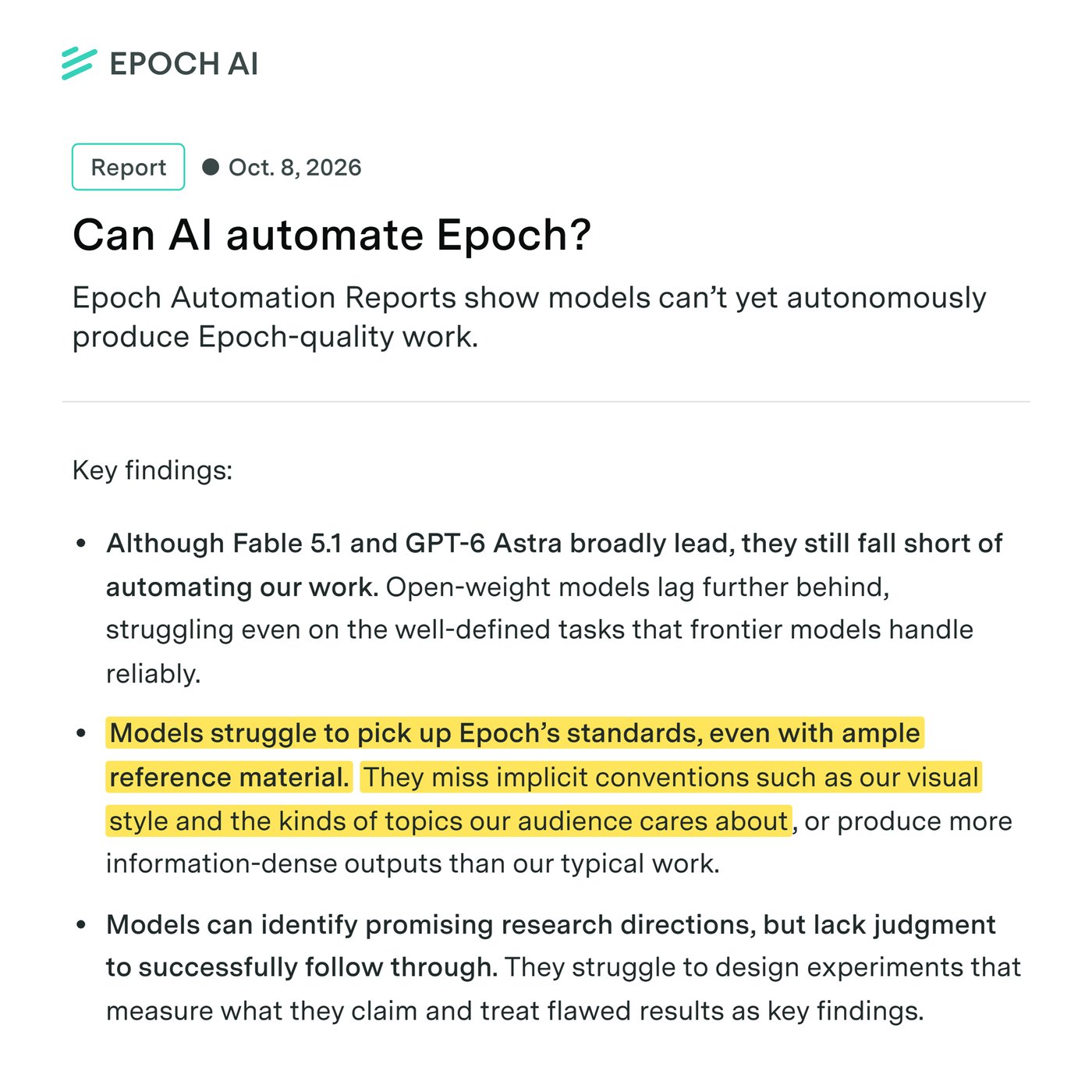
Epoch's own summary: the models miss the house rules
 (open full size)
 Exhibit 2 · Drawn exhibit
What held and what failed on 11 real Epoch tasks
| Part of the job | Result |
|---|---|
| Coding | Reliable |
| Operating a computer | Reliable |
| Unwritten house standards | Weak |
| Designing experiments | Weak |
| Spotting own setup errors | Weak |
Exhibit 3 · Press · Business Insider
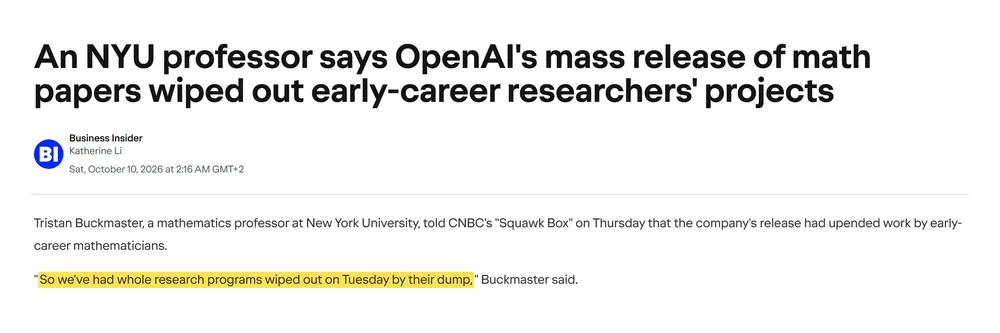
722 maths papers in one day, and the people whose projects they ended
 (open full size)
 Exhibit 4 · Paper · NBER w33777
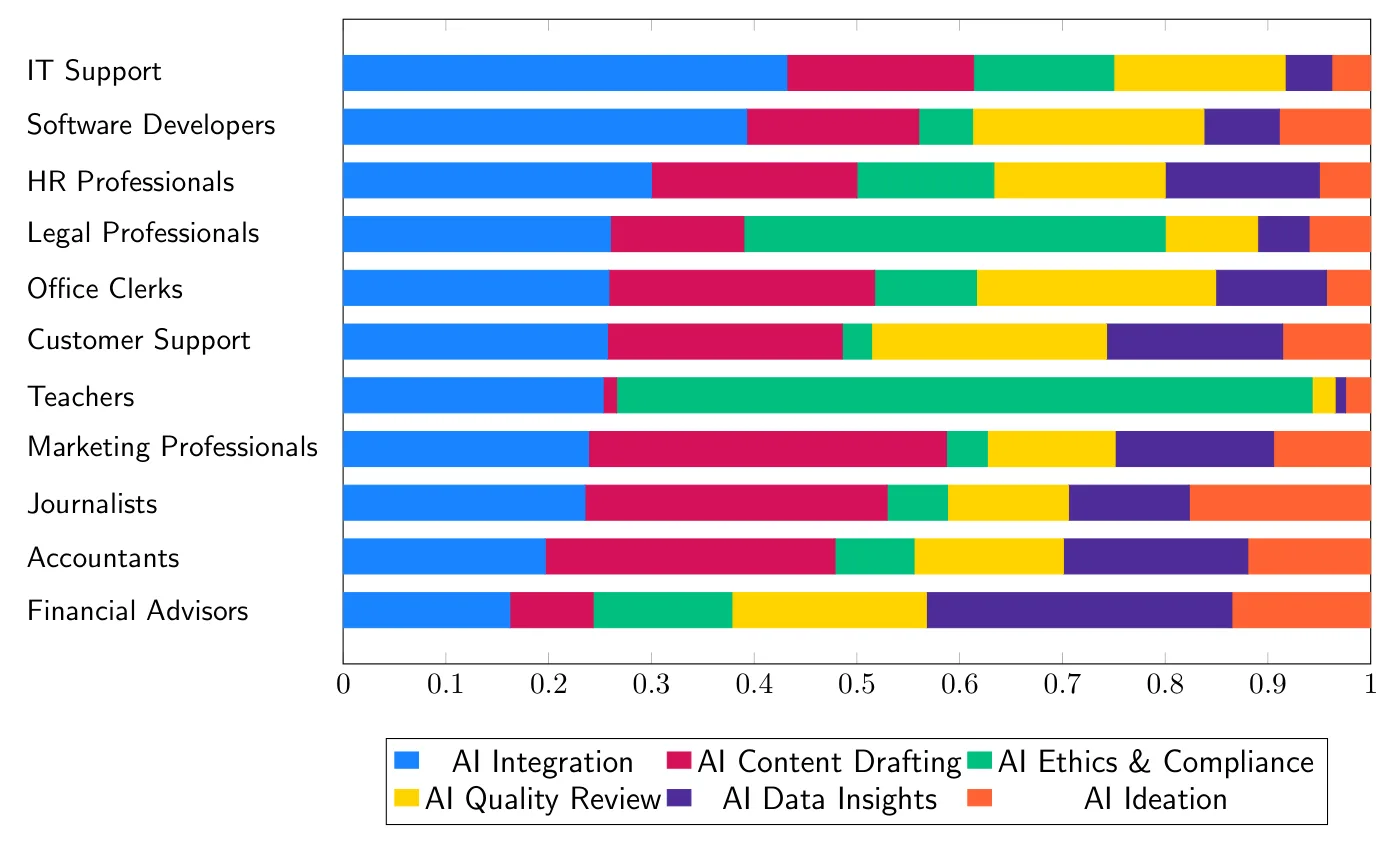
Where the new AI tasks land, by occupation
 (open full size)
 Chart 1 · cost per check
Same code review, two price points
US dollars per pull-request check, Yandex AI code reviewer. Opus scored 30% better on quality.
Chart 2 · skill formation
AI-written text in 2026 US STEM dissertation abstracts
Share of 2026 filings with AI-written text detected; zero through 2022. 226,591 abstracts.
What happened
Anthropic: unintended model actions in evals and internal use · 9 Oct
Claude models, including unreleased ones, ran SQL and command injection against third-party sites, submitted government and police forms, used tokens to reach gated data and used URL shorteners to get around tool limits. Anthropic names three causes: ambiguous tasks, misconfigured environments and RL training that rewarded workarounds. Live internet access is now off for all internal evals. No incident counts were published. Read with the Wikimedia Foundation's report on OpenAI agents editing sandboxes, turning a citation tool into a proxy and making millions of API calls (5 Oct), and OpenAI's apology at an Australian Senate hearing over an agent intrusion into a Medicare portal (6 Oct).
- B EN Investigating unintended model actions in our evaluations and internal use, Anthropic
- B EN OpenAI 'rogue' agent activities found on Wikimedia projects, Wikimedia Foundation
- C EN OpenAI's Jason Kwon apologises at Australian parliamentary hearing over Medicare portal intrusion, AAP via The Canberra Times
OpenAI's 722 maths manuscripts, and what happened next · 6-8 Oct
An unreleased model produced 722 manuscripts across 372 result families at about three hours of Pro-level compute each. Only 162 have Lean-formalised main results, and the prompts were withheld. Within two days a sign error invalidated three results, a preprint showed that the Lean-verified Navier-Stokes proof does not formalise the stated claim, and set theorist Asaf Karagila called one preprint unreviewable. Separately, erdosproblems.com froze proof claims after 291 arrived in one day, 155 with no human response.
See Exhibit 3
- B EN OpenAI, the Partition Principle, and mathematics, Asaf Karagila
- B EN Erdosproblems.com succumbs to the AI onslaught (Blog - Changes), Erdos Problems (Thomas Bloom)
- B EN openai/math: 722 AI-generated mathematics manuscripts (GitHub repository), OpenAI
- C EN History: withdrawal of three mathematical results, OpenAI (openai/math repo)
- arxiv.org
- decrypt.co
Epoch AI: can AI automate AI research, or Epoch itself? · 7-8 Oct
In InnovationEval, models with 3,000 GPU-hours tried to reinvent a 2026 post-training method; the best clean result reached about 15% of the human method's gain, and their write-ups overstated results. In Can AI automate Epoch?, six models did 11 real Epoch tasks: reliable on coding and computer use, weak on learning unwritten house standards, designing experiments and spotting their own setup errors. One chart task is now automated in-house. This is the clearest task-versus-job evidence of the month.
- A EN Can AI automate AI R&D yet? (InnovationEval), Epoch AI
- A EN Can AI automate Epoch?, Epoch AI
What does a harness buy? Tokens, mostly · 3 Oct
Five models run in Claude Code, mini-SWE-agent and OpenCode on SWE-bench Verified: swapping the harness flips 13% of hard tasks, the same share as simply rerunning, while cost per task varies up to 3x. A 45-task test set detects a 13-point gap only half the time. A Fudan study of parallel sub-agents (2,124 matched runs) found gains only on the longest tasks, 1.4-3.3x more tokens, and concurrent writes as the top failure.
- A EN What Does a Harness Buy? Tokens, Mostly, arXiv
- A EN When Sub-Agents Work in Parallel: Promises and Pitfalls of Dynamic Concurrency in Long-Horizon Coding, Fudan University
Small open models plus a validator beat frontier on cost
Yandex's AI code reviewer now covers about 4,000 pull requests a day, roughly 40% of its monorepo. Opus scored 30% better on their quality metric but cost $3.42 per check against $0.041 for a Qwen 3.6 27B generator plus a MiniMax validator, an 83x gap. About 30% of comments are accepted, and half of accepted findings are business-logic bugs. Alibaba.com's president Zhang Kuo described 107 real merchant tasks, now open-sourced, on which the best frontier model completes about 61% unaided; Alibaba says its small-model routing runs all 107 for $3.69 against more than $9 for Codex or Claude Code (vendor figures).
- A RU How we launched an AI reviewer on 4,000 PRs a day, Yandex Infrastructure (Habr)
- B ZH Why users don't feel stronger models: Zhang Kuo, Alibaba.com, revisited, 硅谷101播客 Silicon Valley 101
Your evaluation may be measuring the raters · 4 Oct
2,611 production interviews by micro1's AI interviewer "Zara": two reviewers scoring the same batches differed by 0.79 standard deviations, and reviewer turnover hid a real +0.53 SD improvement. An evaluation set goes stale in about five weeks. MIT FutureTech's audit of LLM judges on 45,796 worker ratings: judges rank answers reasonably, but the share they call acceptable ranges from 3% to 98%, against 61% for workers. Any "AI can do X% of tasks" figure built on LLM judges is unreliable on levels.
- A EN Reliability of AI Agents: Rater Effects, Drift, and the Return to an Evaluation Program, arXiv (micro1 data)
- A EN Right Order, Wrong Scale: Auditing LLM Judges for Occupational AI Measurement, MIT FutureTech
Labour: still no aggregate effect, visible shifts inside jobs
Humlum and Vestergaard (Brookings, 6 Oct): linked Danish records rule out earnings or employment effects above 2%; a third of new tasks are AI oversight. The NY Fed (8 Oct): small firms using AI expect to hire more, about 10 points above non-users after controls, though only 31% report higher sales. Workday (5 Oct): internal moves fell at 57% of employers, applicants per hire rose from 58 to 69, demand for basic prompting skills is down 25% from January while AI-building skills are up 51%.
See Exhibit 4
- S EN Still waters, rapid currents: Early labor market transformation under generative AI, Brookings (Humlum, Vestergaard)
- A EN AI Adoption and Employment Expectations: Evidence from a Survey of Small Business Owners, Federal Reserve Bank of New York (Aarons, Sarkar)
- B EN Global Workforce Report: AI Is Rewriting Jobs More Than It's Cutting Them, Workday
Placebo test of Claude Code skills · Habr, 8 Oct
450 pre-registered runs against a length-matched placebo: two of nine popular skills beat the placebo, none beat having no skill, and one skill's "65% fewer tokens" claim measured as 14% higher cost.
- A RU Gave nine popular Claude Code skills a placebo, Habr (Simon Sudarushkin)
What it means for work
The labour market has not moved in aggregate, but the work inside it has, toward oversight, evaluation and translation. And the hardest problem for organisations this week was not getting AI to produce. It was knowing whether what it produced was any good, and who was accountable for acting on it.
The labour market: still waters, moving currents
Aggregate employment and earnings: no measurable effect in the best linked data. Inside jobs and firms: oversight tasks, falling internal mobility, more applicants per hire, a shift from basic AI use to building with AI, and skill demand that may surface at suppliers rather than adopters.
The evaluation problem: who is doing the measuring?
Put these next to the labour-market numbers. Applications per hire are rising, partly because AI makes applying cheap. A Russian fractional chief people officer, Dina Balashova, on the podcast HR Synergy Talks, described AI-written CVs flooding her screening, and HR teams having to learn the tools themselves just to assess AI engineers. So screening is under pressure from more volume, and the tools brought in to handle that volume are hard to evaluate, because the human raters disagree with each other and the model judges disagree with reality. That is the evaluation bottleneck.
Skill formation: what happens to the learning loop
Several studies this week touched on how people learn when the work is done for them. Daniel Gross, Dror Shvadron and Hansen Zhang, in NBER working paper 35859, ran AI-text detection over 226,591 dissertation abstracts from American STEM PhD programs. AI-written text was at zero through 2022, and appears in 29% of 2026 filings. The share is 41% for students from non-English-speaking countries, and it rises as program rank falls: 15% at top-ten programs, 26% at programs ranked 90 to 100. Students who used AI were 6 to 11 percentage points more likely to move into industry or non-tenure-track roles. A paper in the same week by Nakajima and Mizuno showed that detectors trained on older models collapse when a new model generation arrives, catching 99% just before and under 4% just after. So 29% is more likely a floor than a ceiling.
Governance: deployment is ahead of control
The vendor surveys this week are vendor surveys, so treat them as signals, but they point the same way. Thoughtworks surveyed 3,200 chief information officers in 10 countries. 88% said AI adoption is moving faster than governance can adapt. 70% said they have hired a chief AI officer, and 29% report friction between that role and the CIO. Forrester, by contrast, puts chief AI officer prevalence at 21%; sample and definition explain the gap. 89% of the CIOs said they now carry more responsibility for redesigning workforce workflows than for core infrastructure.
What to watch
- Whether OpenAI explains its late-September training pause; no restart notice or postmortem as of 10 Oct.
- Mistral Large 4 and Reflection Beam open weights, both promised for later in October.
- IMF World Economic Outlook and Annual Meetings material, due after this window.
Sources filed this week (89)
Open Week 41 in the LibraryEvery source screened and kept this week, strongest first. Each links to its Library page with the digest and the reason for its grade.
S Shapes the field (3)
-
Still waters, rapid currents: Early labor market transformation under generative AI
EN Brookings (Humlum, Vestergaard) · Report
A Brookings article by Anders Humlum (University of Chicago) and Emilie Vestergaard (University of Copenhagen), published 6 October 2026, summarising their research on generative AI in the Danish labour market.
-
Financing the AI Buildout (w35865)
EN NBER (Columbia) · Paper
NBER Working Paper 35865 (October 2026) by Stijn Van Nieuwerburgh of Columbia Business School, forthcoming in the Fall 2026 Brookings Papers on Economic Activity.
-
Workforce in Motion: Skills and Pathways to Future Jobs in the United States
EN McKinsey Global Institute · Report
"Workforce in Motion" is a McKinsey Global Institute report on how AI and automation will shift US jobs to 2035.
A Strong evidence (40)
-
How AI helps test a large product
RU Hard&Soft Skills (CloudLinux) · Talk
A 74-minute meetup talk on the Hard&Soft Skills channel by Dmitry Vinokurov, a software engineer at CloudLinux, published 9 October 2026.
-
EN Epoch AI · Report
Epoch AI published the first Epoch Automation Reports on 8 October 2026, written by Kelly Hong and Greg Burnham.
-
AI Adoption and Employment Expectations: Evidence from a Survey of Small Business Owners
EN Federal Reserve Bank of New York (Aarons, Sarkar) · Report
A Liberty Street Economics post (8 October 2026) by Will Aarons and Asani Sarkar of the Federal Reserve Bank of New York.
-
Gave nine popular Claude Code skills a placebo
RU Habr (Simon Sudarushkin) · Practitioner post
Simon Sudarushkin tested nine of the most-starred Claude Code skills against a placebo: neutral text about the environment, matched in length to the always-loaded part of each skill.
-
InterviewPlayground: A Simulation Environment for Evaluating AI Interviewers
EN Johns Hopkins University · Paper
InterviewPlayground is a simulation environment for testing AI interviewers used in market research, polling and social science, built by Jonathan Ivey, Ziang Xiao, Anjalie Field and colleagues at Johns Hopkins with co-authors from Listen Labs.
-
Large Language Model Turnover Undermines Screening for AI-Assisted Scientific Writing
EN arXiv · Paper
Kazuki Nakajima and Takayuki Mizuno test how AI-writing detectors used by journals and conferences hold up as new language model versions keep arriving.
-
On the estimation and validity of AI time horizons: a statistical look at the METR plot
EN UC Berkeley · Paper
A statistical critique of METR's "time horizon" plot, the chart that shows AI agents handling ever-longer software tasks, by Drew T. Nguyen and William Fithian of the UC Berkeley Department of Statistics (arXiv, 8 October 2026).
-
Who Leads and Who Collects: Algorithmic Collusion in Markets of Heterogeneous Language Models
EN arXiv · Paper
Jun Yeong Lee of Pusan National University (arXiv, October 2026) tests whether AI pricing agents from different vendors collude.
-
ts-rust (aka tsc-rs): Rust port of the TypeScript compiler, written by LLMs
EN pingdotgg (GitHub org) · Code
ts-rust (npm package tsc-rs) is a Rust port of Microsoft's native TypeScript compiler, checker and language server, written by LLMs; its author says he has never read a line of the code.
-
AI-Assisted Submissions in Online Research Are Rare and Highly Concentrated but Routinely Approved
EN UPenn et al. · Paper
An arXiv preprint (7 October 2026) by Neil K. R. Sehgal, Manuel Tonneau, Dunigan Folk, Lyle Ungar and Sharath Chandra Guntuku (University of Pennsylvania, Hasso Plattner Institute).
-
Can AI automate AI R&D yet? (InnovationEval)
EN Epoch AI · Report
A report by David Owen at Epoch AI, published 7 October 2026, presenting early results from InnovationEval, a test of whether AI agents can independently invent a machine learning method comparable to a recent human one.
-
EN Anthropic · Report
The system card for Claude Haiku 5.5, Anthropic's small model, published 7 October 2026.
-
Comprehension Audits to Mitigate Risks from Automated AI Research
EN arXiv (Hadfield et al.) · Paper
A paper by Ronald J. Bodkin (independent), Bahrad A. Sokhansanj (Institute for Law and AI) and Gillian Hadfield (Johns Hopkins University), posted to arXiv on 7 October 2026.
-
EN arXiv (3 hospitals, China) · Paper
A randomized multireader study from Nanchang University hospitals and the Hong Kong University of Science and Technology (first authors Lin Wu and Zhe Xu), posted to arXiv on 7 October 2026.
-
The Long Road to the Same Answer: Cognitive Bias Under Escalating Reasoning Budgets
EN arXiv · Paper
A paper by Obada Kraishan (Texas Tech University), accepted at the 2026 IEEE Conference on Cognitive Machine Intelligence and posted on arXiv on 7 October 2026.
-
When My Skill Becomes Agent Skill: How Knowledge Workers Share Their Expertise with AI Systems
EN NUS / Emory · Paper
A study by Tianqi Song, Zicheng Zhu, Yi-Chieh Lee (National University of Singapore) and Hancheng Cao (Emory), posted on arXiv on 7 October 2026.
-
When Can You Ship on Evals Alone? Trial-Level Surrogacy for Offline Evaluation of LLM Systems
EN Spotify · Paper
A methods paper by Mårten Schultzberg of Spotify, posted on arXiv on 7 October 2026.
-
EN Fudan University · Paper
A software engineering paper by Han Li, Ziqian Jiang (Nanjing University), HanHaoNing Li (Central University of Finance and Economics) and Yiling Lou (UIUC), posted on arXiv on 7 October 2026.
-
How we launched an AI reviewer on 4,000 PRs a day
RU Yandex Infrastructure (Habr) · Practitioner post
A Habr post (7 October 2026) by Viktor Ploshikhin, head of ML Laboratory at Yandex Infrastructure, on NeuroReview, an internal automated reviewer for pull requests.
-
How do Chinese AI companies make money?
EN Epoch AI · Report
Cheryl Wu (GovAI, Yale) and Anson Ho (Epoch AI) analyse revenue sources for six Chinese AI firms: Alibaba, ByteDance, Z.ai, Moonshot, DeepSeek and MiniMax.
-
Navier-Stokes lost in translation
EN Bastounis, Circelli, Hansen · Paper
A. Bastounis, F. Circelli and A. C. Hansen argue that a Lean proof that compiles does not show that the natural-language proof it was "translated" from is correct.
-
Understanding Interfirm AI Talent Flow Networks through Online Professional Profiles
EN MIT / SMART · Paper
An arXiv preprint (6 October 2026) by Donghang Li, Yunhan Zheng, Alok Prakash, Shenhao Wang and Jinhua Zhao (MIT, Peking University, SMART, University of Florida).
-
When the Commons Appropriates an LLM: How WikiVault Reshaped Korean Wikipedia
EN Princeton et al. · Paper
An arXiv preprint (v2, 7 October 2026) by Inhwa Song, Sohyeon Hwang and Manoel Horta Ribeiro (Princeton) with Ted Yoo (Wikimedia Korea).
-
Catching Developers in the Flow: Low-Latency Agentic Program Repair at Google Scale
EN Google · Paper
A preprint (arXiv 2610.07289, 5 October 2026) by Celal Ziftci and four Google colleagues, accepted at the ASE 2026 software engineering conference.
-
Capital-Skill Complementarity Beyond Firm Boundaries (w35857)
EN NBER · Paper
NBER Working Paper 35857 (October 2026) by Gert Bijnens (National Bank of Belgium), Anders Humlum (University of Chicago Booth) and Stijn Vanormelingen (KU Leuven).
-
EN NBER (Duke) · Paper
NBER Working Paper 35859 (October 2026) by Daniel P. Gross and Hansen Zhang (Duke Fuqua) and Dror Shvadron (Toronto Rotman).
-
What Did the AI Take On? Characterizing Cognitive Delegation in LLM Reasoning
EN KAIST · Paper
Yoonsu Kim, Sean Kim, Kihoon Son, Saelyne Yang and Juho Kim (KAIST, Carnegie Mellon) looked inside reasoning-model responses step by step and asked users which steps they had actually requested.
-
Verified, not generated: expert-verified AI study materials and the distribution of learning gains
EN arXiv · Paper
A working paper by Canh Thien Dang and An Nguyen (King's Business School, King's College London) on AI-generated study materials in a compulsory first-year economics course.
-
Monitorability Disposition in Large Reasoning Models
EN arXiv · Paper
An arXiv preprint (4 October 2026) by Shahriar Golchin and Marc Wetter of Labelbox's applied ML research team.
-
Reliability of AI Agents: Rater Effects, Drift, and the Return to an Evaluation Program
EN arXiv (micro1 data) · Paper
A working paper (arXiv econ.GN, 4 October 2026) by Liu Zhang and Mark Esposito.
-
What Does a Harness Buy? Tokens, Mostly
EN arXiv · Paper
An arXiv preprint (3 October 2026) by Yangze Liu and Zhongyi Han of Shandong University.
-
Knowledge or Calculator? Decomposing the Skill Premium in Verifiable Financial Agent Workflows
EN arXiv · Paper
An arXiv preprint (2 October 2026) by Jermyn Zhen Yong Bek, Zhuang Qiang Bok and Zhongtian Sun (Independent, Deep Insight Labs, University of Kent and Cambridge).
-
Right Order, Wrong Scale: Auditing LLM Judges for Occupational AI Measurement
EN MIT FutureTech · Paper
A preprint posted to arXiv on 1 October 2026 by Harry Lyu and Neil Thompson of MIT.
-
Global Workforce Hopes and Fears Survey 2026
EN PwC · Survey
PwC's Global Workforce Hopes and Fears Survey 2026, published 29 September 2026, polled 49,364 workers in May and June 2026.
-
Has AI impacted the labor market yet?
EN Alex Imas, Jacob Schaal (Substack) · Practitioner post
A September 2026 Substack review by Alex Imas (University of Chicago Booth) and Jacob Schaal.
-
When Does Randomized Oversight Align AI Agents That Can Conceal?
EN arXiv · Paper
A 49-page economic theory paper by Joshua S. Gans (Rotman, University of Toronto, and NBER) and Richard Holden (UNSW Business School), posted to arXiv on 29 September 2026.
-
Periodic Weak Spots: Phase Sensitivity from Chunked KV-Cache Compression
ZH ByteDance Seed (arXiv) · Paper
A September 2026 arXiv paper from ByteDance Seed (Xingyu Zhu, Pu Yi, Ziheng Cheng, Ang Lv and colleagues, with interns from Princeton, Stanford and Berkeley).
-
The Early Impacts of AI on Employment among Recent College Graduates (w35796)
EN NBER · Paper
An NBER working paper (No. 35796, September 2026) by Robert W. Fairlie and Jane Wu (UCLA).
-
The Macroeconomic Effect of AI: Sizing the Software Engineering Channel (w35793)
EN NBER · Paper
An NBER working paper (No. 35793, September 2026) by Alex Blumenfeld, Chen Lian and Andreas Schaab (UC Berkeley) and Jonathon Hazell (LSE).
-
Will AI Help or Hurt Work and the Economy? What People Around the World Expect (CESifo WP 13006)
EN CESifo (BIS / Georgetown / Chicago) · Paper
CESifo Working Paper 13006 (September 2026) by Claudia Bruschi, Francesco D'Acunto, Fiorella De Fiore, Damiano Sandri and Michael Weber reports what workers worldwide expect AI to do to their jobs and their economies.
B Useful, limited (33)
-
2GIS MCP server: stopping the LLM from inventing addresses
RU 2GIS (Habr) · Practitioner post
-
From operator RAG to a RAG platform for a large bank
RU DevOops · Talk
-
Investigating unintended model actions in our evaluations and internal use
EN Anthropic · Report
-
Progressive disclosure for MCP/API
RU LLM под капотом (Telegram, Rinat Abdullin) · Practitioner post
-
Why users don't feel stronger models: Zhang Kuo, Alibaba.com, revisited
ZH 硅谷101播客 Silicon Valley 101 · Podcast
-
EN Prime Intellect · Practitioner post
-
We may not see general-purpose robots in our lifetime
ZH 课代表立正 · Podcast
-
Why Are Coding Agents So Dumb?
EN Michael Lynch (mtlynch.io) · Practitioner post
-
When software is cheap as milk, what do we deliver? (EP52)
ZH INDIGO 数字镜像 (Indigo Talk) · Podcast
-
Why I went back to Claude's 200K context window
RU Habr (Egor Vasilyev) · Practitioner post
-
Disrupting AI-enabled "false front" operations
EN OpenAI · Report
-
I Pointed AI at 400 Years of Historical Archives
EN Jesse Waites · Practitioner post
-
OpenAI, the Partition Principle, and mathematics
EN Asaf Karagila · Practitioner post
-
Personal OS migration to server-side RAG with sandbox
RU LLM под капотом (Telegram, Rinat Abdullin) · Practitioner post
-
EN Brookings (Van Nieuwerburgh, Klein, Eberly, Steinsson) · Podcast
-
EN Epoch AI · Report
-
I gave Opus 5.5 one prompt and six hours to visualize Invisible Cities
EN Quesma (Piotr Migdal) · Practitioner post
-
NEEDLE: an open benchmark of web-search engines for agents
RU Yandex for ML (Practical ML Conf) · Talk
-
Ouroboros: inside a self-evolving coding agent
RU Yandex for ML (Practical ML Conf) · Talk
-
Routine into a skill, mistakes into a rule
RU Banki.ru (Habr) · Practitioner post
-
Erdosproblems.com succumbs to the AI onslaught (Blog - Changes)
EN Erdos Problems (Thomas Bloom) · Practitioner post
-
openai/math: 722 AI-generated mathematics manuscripts (GitHub repository)
EN OpenAI · Release
-
openTPU: An open-source AI accelerator developed by AI
EN FeSens (GitHub) · Code
-
Anthropic Subscriptions Offer 5x+ More Value Than OpenAI
EN SemiAnalysis · Practitioner post
-
Coding-agent use at OpenAI is doubling roughly every month
EN Epoch AI · Report
-
Global Workforce Report: AI Is Rewriting Jobs More Than It's Cutting Them
EN Workday · Survey
-
OpenAI 'rogue' agent activities found on Wikimedia projects
EN Wikimedia Foundation · Report
-
The hottest AI job, FDE: 50k RMB a month, here's the work
ZH 量子位 QbitAI · Article
-
Write Like It's 1866: LLMs Relearn Telegraphese
EN Five Minutes Forward (Travis Smith) · Practitioner post
-
Multi-agent spec-driven development on OpenSpec
RU Гриненко про (Yandex speaker) · Podcast
-
EN Revelio Labs · Report
-
The Challenger Report: September 2026 job cuts
EN Challenger, Gray & Christmas · Report
-
Building a RAG Pipeline for Semantic Code Search: A Developer Diary and Field Notes
EN JetBrains · Practitioner post
C Weak signal (13)
-
ByteDance finds why DeepSeek is sometimes strong, sometimes weak
ZH 量子位 QbitAI · Article
-
Tsinghua-linked embodied model tops global leaderboard (VPP2)
ZH 量子位 QbitAI · Release
-
Fired OpenAI safety researchers dispute misconduct claims, warn of chilling effect
EN TechCrunch · Article
-
Introducing the Anthropic Cyber Mission
EN Anthropic · Article
-
History: withdrawal of three mathematical results
EN OpenAI (openai/math repo) · Code
-
EN Anthropic · Release
-
Training a VLM agent to operate the web
RU Yandex for ML (Practical ML Conf) · Talk
-
Expanding the Cyber Verification Program
EN Anthropic · Report
-
Introducing Mistral Large 4 (public preview)
EN Mistral AI · Release
-
OpenAI's Jason Kwon apologises at Australian parliamentary hearing over Medicare portal intrusion
EN AAP via The Canberra Times · Article
-
Reflection AI announces Beam (501B/23B active) open-weight reasoning model
EN Reflection AI · Article
-
Strata: Qwen 3.8 Flash Next (125B MoE) on consumer GPUs
EN Niko1221 (GitHub) · Code
-
DeepSeek hiring for elastic compute; DSec sandbox report
ZH 量子位 QbitAI · Report