Week 7 · 2026 · Post
HBR: AI does not reduce work, it intensifies it
HBR just published a warning: "AI Doesn't Reduce Work — It Intensifies It"
I read it as a confirmation that it's working.
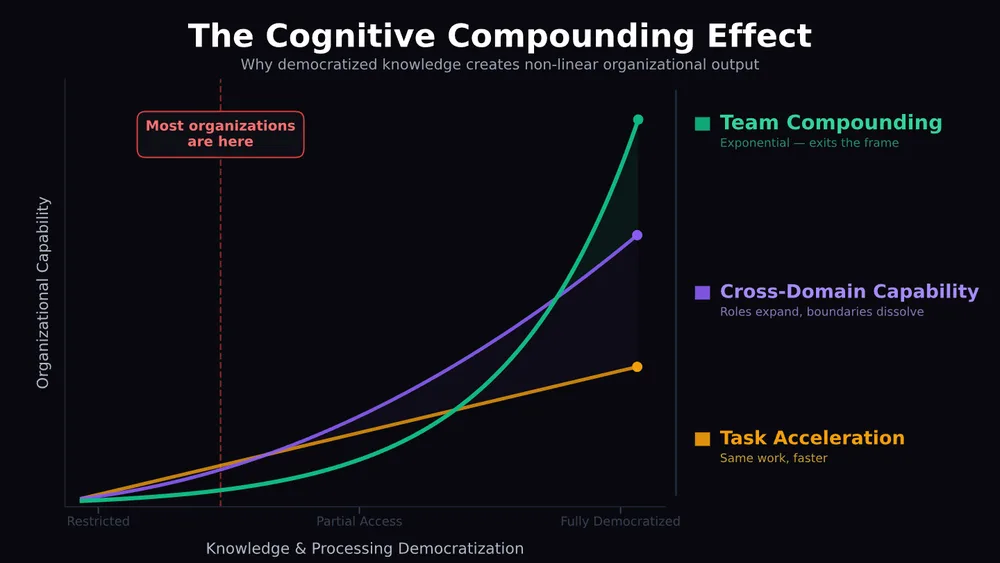 Open full-size exhibit
 UC Berkeley tracked a 200-person tech company for eight months. Product managers started writing code. Researchers picked up engineering tasks. Role boundaries dissolved. People worked more, not less. By month six - burnout, anxiety, decision fatigue.
Yes, AI intensifies work. That's the whole point. The question is whether you're intensifying in the right direction - compressing process to expand what you're capable of, or spinning the same wheel at higher RPM.
Last Friday I sat down at 9 AM to prepare two pitch decks and pull together research for a third workstream. By noon I had three distinct products ready to push forward. A year ago, that's a full week. The mechanical work - compressed into hours.
What opened was the cognitive bandwidth. And cognitive bandwidth, unlike calendar time, compounds when you reinvest it.
That's the shift the Berkeley researchers documented but framed as a problem. People expanded into unfamiliar territory. They crossed role boundaries. They took on work that wasn't "theirs". The study treats this as erosion. I think it's closer to what happens when you remove artificial constraints from capable people and they find out what they can actually do.
Now apply this to a traditional organization. Not a tech startup - a multinational with established functions, reporting lines, job families built over decades. The entire architecture assumes one person, one specialty, sequential work. You stay inside your domain. You escalate to specialists when you hit the boundary of your role.
That architecture was built for a world where crossing boundaries was expensive. AI made it cheap. A finance controller building scenario models without a data analytics team. A supply chain manager running demand forecasting without a planning specialist. A commercial lead pulling together competitive intelligence and market sizing in an afternoon. A talent manager doing rewards benchmarking and HRBP-level workforce planning because the processing barrier disappeared.
People discovering their expertise was always broader than their job description allowed.
The organizational design question is now: do you build for this, or do you fight it?
The teams that restructure around expanding capability will compound. Every person brings a wider surface area to every problem. Output doesn't grow linearly. It accelerates.
The teams that keep people in boxes will get exactly what boxes produce: sequential, narrow, one-thing-at-a-time work. While someone else runs four workstreams before lunch.
We're early. But the gap between organizations that catch this and those that don't will be measurable within a year. Not in AI adoption metrics. In output, speed, and the kind of talent that chooses to stay.
Are your teams structured for who your people are becoming?