Week 28 · 2026 · Post
Start with the output and let it pull the data

The dominant narrative in the feed repeats the same rigid prerequisite: you cannot adopt AI until your data is perfectly clean.
This premise shrinks AI to a narrow set of safe use cases and creates an artificial barrier to building real capability. We treat enterprise data like a concrete foundation that must be poured perfectly before a single brick is laid.
 Open full-size exhibit
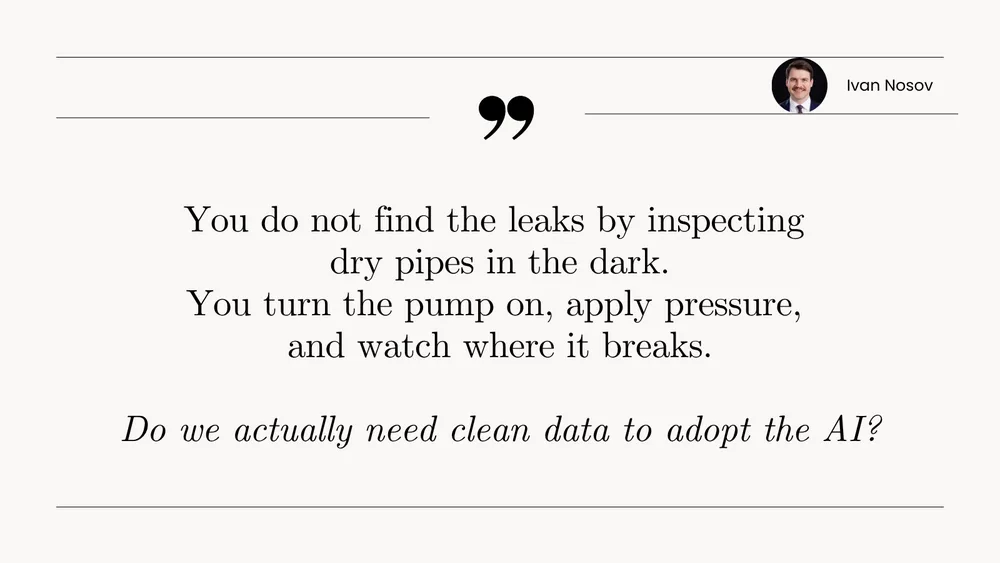
 In reality, data behaves like a pressurized system. You do not find the leaks by inspecting dry pipes in the dark. You turn the pump on, apply pressure, and watch where it breaks. The AI output is the pressure.
You do not need "good enough" data to start, because good enough is an illusion until the data is actually used.
Until we began chatbot adoption, policy coherency was largely invisible. The moment AI tried to generate answers from those policies, contradictions and gaps surfaced immediately. The same happened when we data extracts became enabled by ad-hoc dashboarding: issues that had stayed hidden became operational blockers within days.
Because you can have rapid output, you have incentive to stabilize input till the system starts to "click".
I really like the Americana Foods example. According to Beam's case study, they started with month-end flash reporting while running a 20-30 year legacy on-prem Oracle ERP with no APIs and Excel-heavy reporting across business units and geographies. If they had waited for full architecture modernization, they would still be waiting.
Beam states the agent handled input collection, follow-ups, escalations, consolidation, and CFO report commentary, with human review before reports reached leadership. The same source says the workflow went live in production in under 30 days.
It solves the chicken-or-egg problem of AI readiness. You do not clean data to build a solution. You build a solution that makes data debt visible, then improve the foundation while the wheel is already turning.
The sequence flips: start with the idea, build the output, let the output pull the data.