Week 41 · 2026 · Post
OpenAI's 722 maths papers and the shape of jobs
.jpg)
This week mathematics showed how the shape of many jobs will change, and it happened faster than anyone planned for.
On Tuesday, 6 October, OpenAI published 722 mathematics papers written by an internal model it has not released - 372 families of results, from about 4,000 problems it gave the model.
 Open full-size exhibit
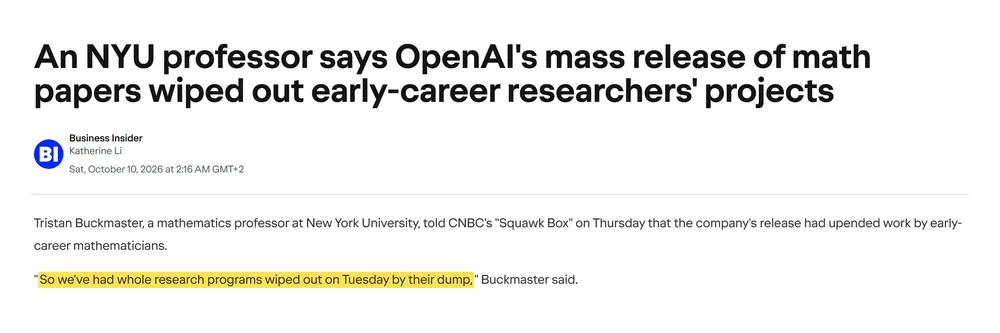
 Two days later Tristan Buckmaster, a mathematics professor at NYU, said on CNBC: "We've had whole research programs wiped out on Tuesday by their dump".
His concern is early-career mathematicians, who build a career on a few open problems. Some of those problems are now closed, by a model nobody outside OpenAI can use. Mathematics is a clear case because results are public and dated.
In most jobs the change is slower and quieter, but it works the same way: a piece of work someone expected to own becomes cheap overnight. What I find useful is where mathematicians see the value moving.
Alex Kontorovich at Rutgers said mathematics teaches people "to think clearly and deeply and for extended periods of time on big problems", and he expects more demand for that skill.
OpenAI's own advisory group called the release "the beginning, not the completion, of the process of human understanding". Someone still has to check 722 papers, decide which results matter and build on them.
This is close to how I think about reskilling. In some areas people will work with the model and do much more. In others the model will do the work, and pretending otherwise helps nobody. So the useful step is an honest look at which part of a role is which, and then putting the training time into the part that grows: choosing the problems worth solving, judging whether a result holds, connecting it to what the business needs.
For early-career mathematicians this week is painful. For the rest of us it is an early look on what to expect, while there is still time to plan for it.