AI at Work: Why Strategy Matters More Than Tools
S · Shapes the field The fourth edition of BCG's flagship workforce AI survey, with 11,749 respondents in 14 markets and a four-year trend line that is widely cited in the adoption debate.
Summary based on the full text·Original: about 20 minutes to read
In short
BCG's AI at Work 2026 (June 2026, fourth edition) surveys 11,749 leaders, managers and frontline white-collar employees in 14 markets. Frontline use has caught up: 74% now use AI regularly. Individual time savings are large, but they do not turn into value without direction. Respondents who report clear AI strategy and limited tool access report more measurable impact than those with strong access but no direction. Agents are moving into workflows faster than governance for mixed human and AI teams.
Key numbers
- 74%frontline employees who are regular AI users, up 23 points from 2025
- 66%frontline regular users who get limited or no guidance on what to do with time saved
- 80% vs 60%measurable impact with strong strategic clarity and limited tools vs limited clarity and strong tools
- 13% to 30%respondents reporting AI agents integrated into workflows, 2025 to 2026
As reported by the source.
English·Web page·opens bcg.com
Figures from the source
Exhibit 1
Strategy clarity beats tool access
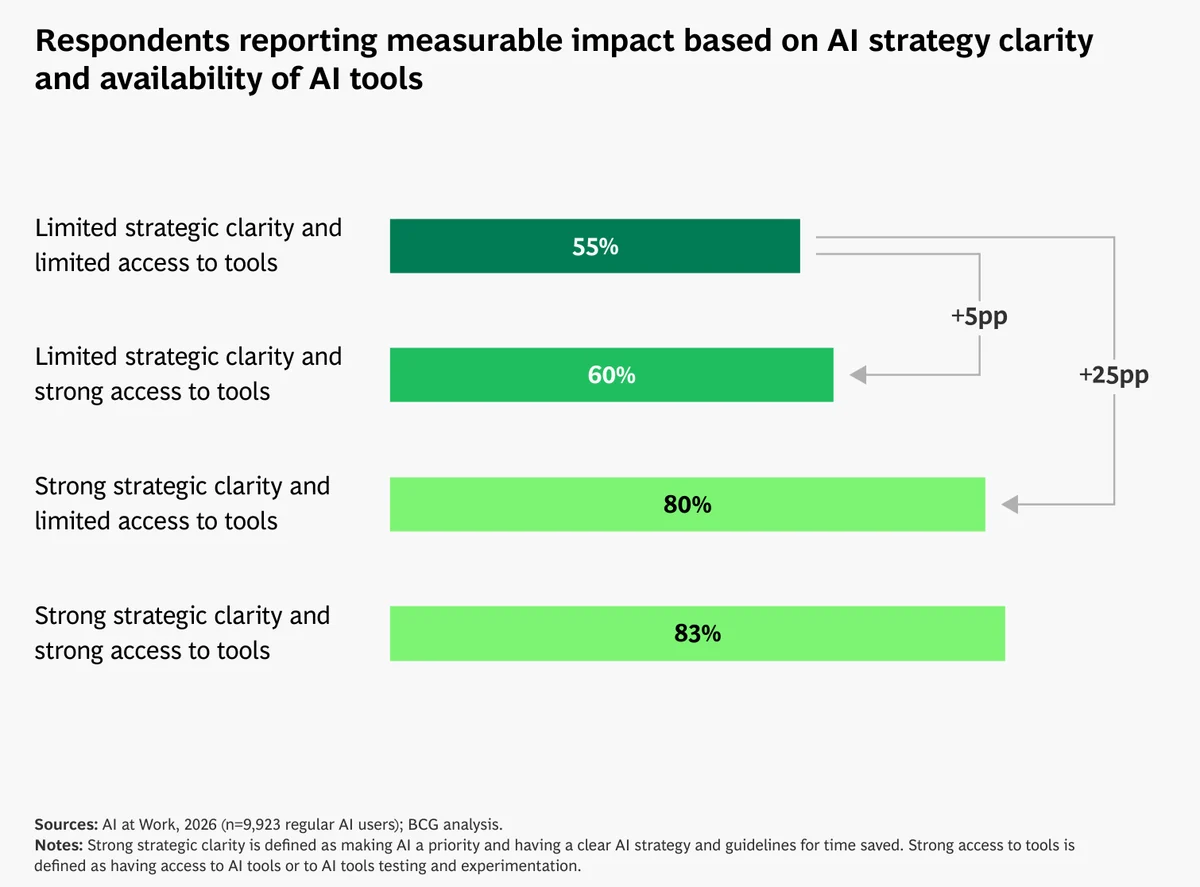
Exhibit 2
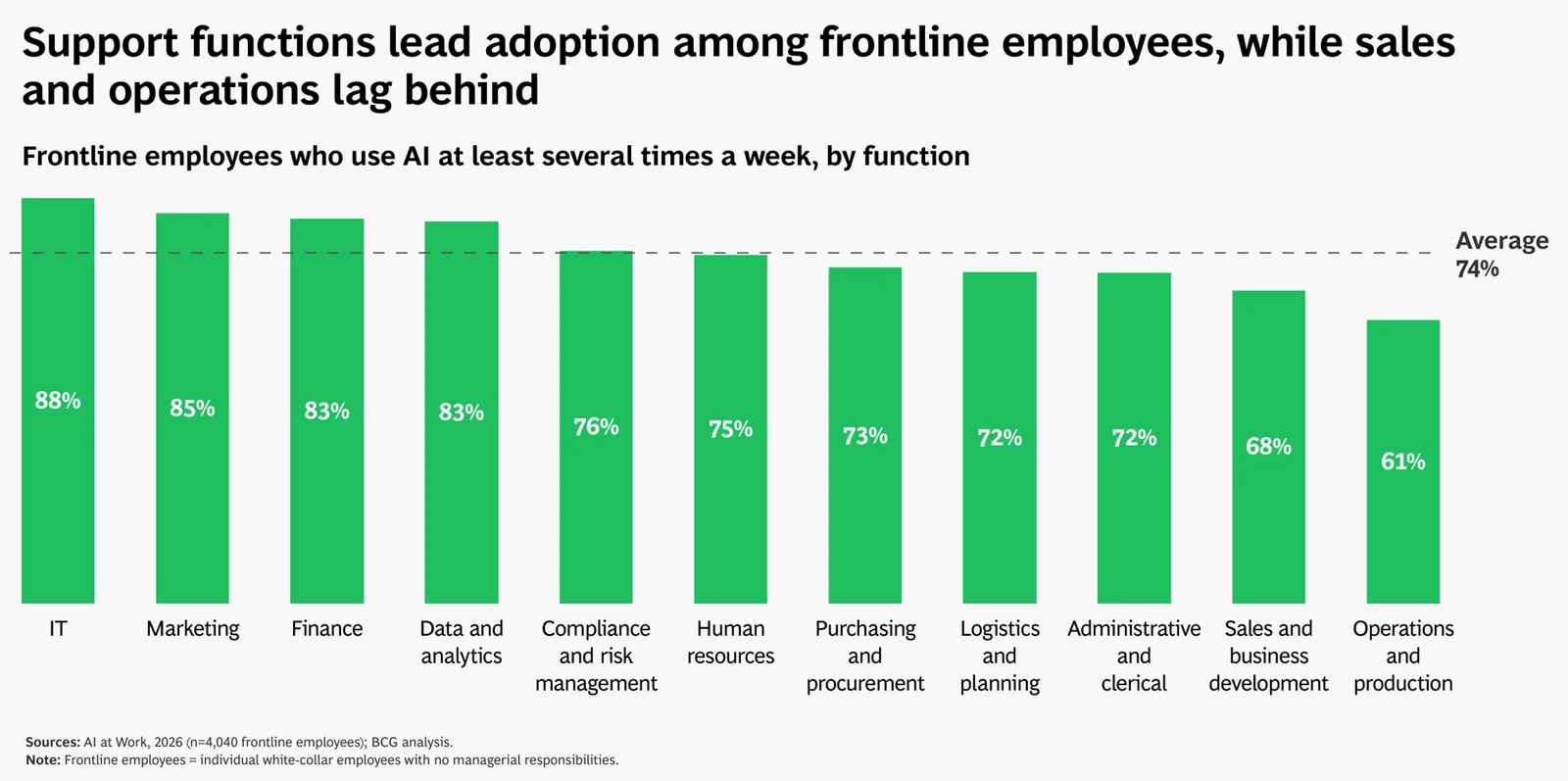
Frontline AI use by function
What it reports
- Regular AI use (daily or several times a week): frontline 74% (51% in 2025), managers 88%, leaders 93%. By market, frontline use ranges from 95% in India down to 62% in the US, France and Italy.
- Among regular users, 42% of frontline staff, 52% of managers and 60% of leaders save at least a workday per week. Yet 66% of frontline users get limited or no guidance on using that time, and more than half do not redirect it to strategic work.
- Organisations "inventing" new business models with AI rose from 22% to 42%; "reshaping" end-to-end workflows from 50% to 57%; plain "deploy" from 72% to 78%.
- Employees at Reshape or Invent companies report more of everything than Deploy-only companies: saving a day a week 53% vs 31%, measurable business improvement 67% vs 43%, full trust in leadership's AI communication 44% vs 26%.
- Measurable impact by condition: 55% (limited clarity, limited tools), 60% (limited clarity, strong tools), 80% (strong clarity, limited tools), 83% (both).
- 88% expect to need major upskilling within five years; 36% feel properly trained, unchanged from 2025. Only 33% of frontline staff say leadership communicates clearly about AI.
- 67% of regular users enjoy work more; 41% report increased mental strain (48% of leaders).
- 61% believe agents could do at least half their job within three years; 50% say their company has no clear guidance on managing human and AI teams.
How they got it
An online survey of 11,749 respondents in 14 markets, split roughly evenly between leaders, managers and frontline employees, at companies from $100M to over $10B in revenue. Comparisons use subsamples, for example 8,989 regular users for time-saved figures and 10,990 for the Deploy vs Reshape/Invent split. Trend lines use the 2023-2025 editions.
Limits
- Time saved, impact and enjoyment are self-reported; there is no output or financial data.
- The strategy-versus-tools comparison is cross-sectional correlation; firms with clear strategy may differ in other ways.
- BCG sells the workflow-redesign and CEO-led transformation work that the five recommendations describe.
Why it matters for companies
The bottleneck has moved from access to direction: most staff already use AI, and the savings leak away unless someone decides where the freed time goes. Leaders report far more benefit than the frontline, so leadership's view of adoption is likely too optimistic. The practical steps are concrete: measure business outcomes instead of usage, redesign a few core processes end to end, and set rules for teams where agents do part of the work before agents spread further.
Summary based on the full text. Read the original for the full argument and data.Read the original on bcg.com